
What are Talk Trees?
Talk Trees are visualizations that highlight high-leverage student talk that support learning called academically productive talk¹. Talk Trees visualize student talk in the form of a flowering tree which helps teachers and students notice and celebrate class discussions and participation.
How do they work?
The first step is to capture a lesson, either by streaming directly through the app or by uploading an audio or transcript file. Next, our in-house tools anonymize the data, deleting the original files that may contain identifying information. What is left is the visualization of student talk, represented by the different color flowers and leaves.
What can I do with them?
The goal of Talk Trees is to foster productive classroom conversations and grow student voice. You can use Talk Trees to engage in reflective practice² by sharing them with students to recognize their ideas and encourage discussion. You can use them in classroom activities such as celebrating student talk or comparing trees between different lessons, setting specific goals, etc.
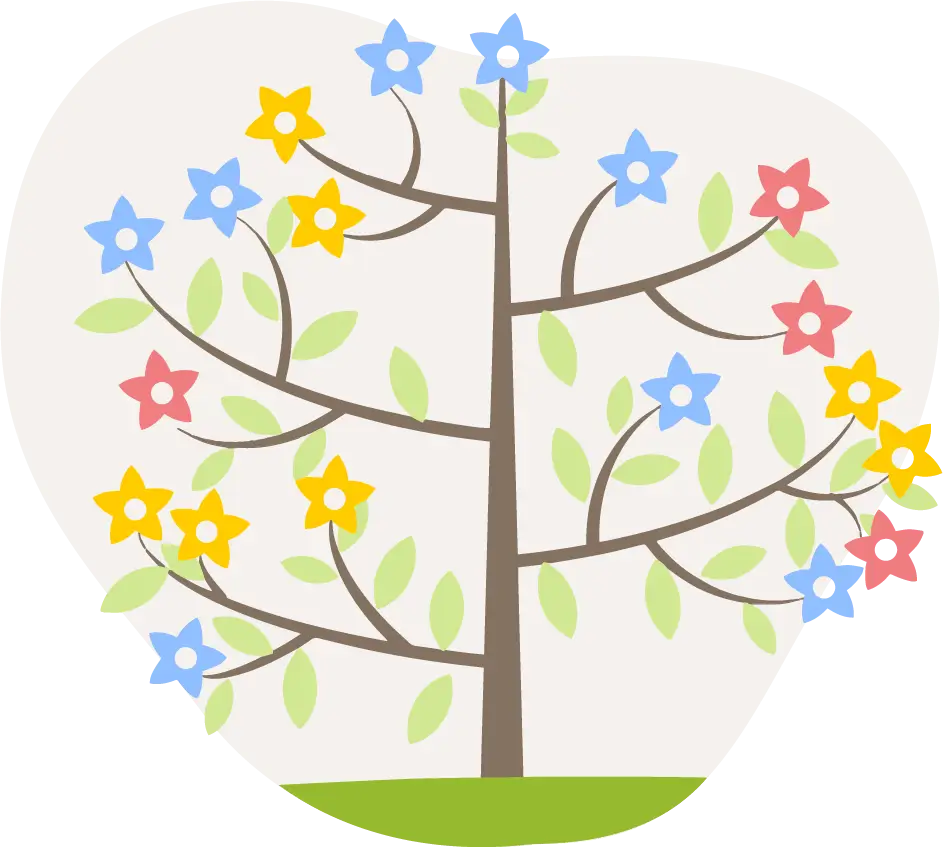

Blue flowers: Making a claim

Red flowers: Providing evidence

Yellow flowers: Relating to another student

Leaves: Any student talk
O'Connor, C., Michaels, S., & Chapin, S. (2015). "Scaling Down" to Explore the Role of Talk in Learning: From District Intervention to Controlled Classroom Study.
Hattie, J., & Timperley, H., (2007). The power of feedback. Review of Educational Research.