
Why does talk matter?
Talk Trees centers student talk. Research shows that when students talk, it helps them become active learners rather than passive listeners¹. While classrooms often follow a pattern where teachers do most of the talking and students listen, the use of academically productive talk helps break that pattern and encourages students to share ideas, explain their thinking, and learn from one another. Research shows these discussions support deeper engagement and enhanced student learning².
How do I talk about talk with my students?
You can use Talk Trees to encourage students to reflect on how they contribute to classroom discussions. This helps build a classroom culture where every voice is valued and talk is seen as an important way to increase engagement and learning.
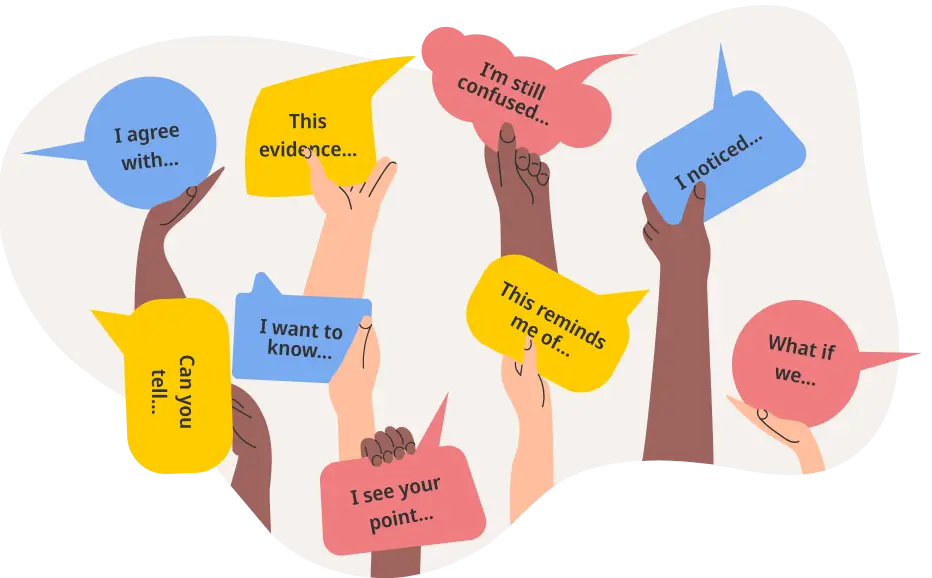
Start small. Simple questions or sentence starters like “I notice…” or “I agree/disagree because…” can help students begin participating.
Celebrate participation. Acknowledge student contributions, for example, by repeating or highlighting what they said, to reinforce talk as a classroom norm.
Reflect together. Regular opportunities to reflect on classroom conversations help students connect participation to learning.
Set goals. Once students understand expectations, encourage them to set personal goals for participation to support growth, not evaluation.
Check-in reflection
How many opportunities has each student gotten to share their voice?
Are students explaining their thinking to and with each other?
When students are talking, are they only sharing with the teacher or are they building on what other students have said as well?
Chi, M. T., & Wylie, R. (2014). The ICAP framework: Linking cognitive engagement to active learning outcomes.
Resnick, L. B., Michaels, S., & O'Connor, M. C. (2010). How (well-structured) talk builds the mind.